Data protection
34 cameras, 22 months: 15,000 euros in damages
Tobias Reinhardtapprox. 7 min read
A company filmed its entire production hall around the clock with 34 cameras, in HD and with a live feed. The Regional Labour Court of Hamm awarded a production worker 15,000 euros in damages for this. The ruling shows what hurdles apply to video surveillance in the workplace and what the lack of a proper concept can cost.
 AI-generated
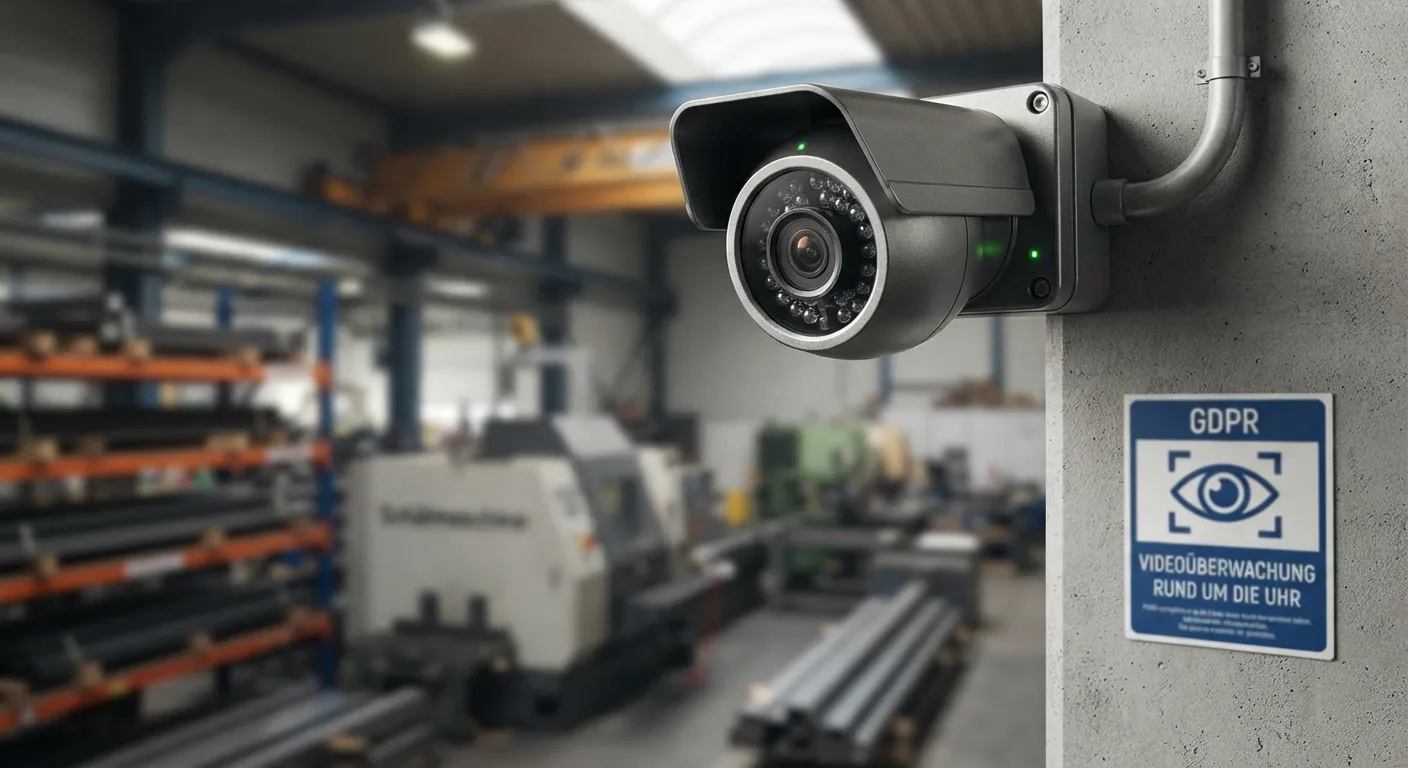
Anyone fitting out a production hall with wall-to-wall cameras needs demonstrable reasons and a concept that keeps the intrusion to a minimum. If both are missing, it gets expensive. In a judgment of 28.05.2025 (18 SLa 959/24), the Regional Labour Court of Hamm awarded a production worker 15,000 euros in compensation. His employer had filmed him on every working day for 22 months, despite his objection.
The case: 34 cameras in the production hall
The employer manufactures steel blocks weighing several tonnes. Its 15,000 square metre production hall, including storage areas and offices, was fitted with 34 video cameras. In the hall, the storage area and a connecting corridor they recorded the entire area around the clock. The footage was in HD quality and was kept for at least 48 hours. Signs at every access door pointed out the surveillance. Only the break room, the changing rooms and the toilets remained camera-free.
The claimant had worked at the plant since January 2023, operating a peeling machine. A camera behind him covered the loading and unloading area of the machine. Most of the time he stood with his back to it, but as soon as he turned round or left his workstation, it filmed him from the front. Three further cameras also showed when he was on his way to the office, the break room or the toilet.
As early as 2023 the employee had brought a claim over the cameras and obtained information by way of a settlement. He considered it incorrect and inadequate and demanded in December 2023 that the surveillance be stopped. The employer carried on filming unchanged. In March 2024 he brought a claim for an injunction, information and at least 7,000 euros in compensation; in September 2024 his dismissal followed. The employment relationship ended by settlement on 31 October 2024.
What the court decided
The Labour Court of Dortmund awarded the employee 15,000 euros, more than twice the minimum amount claimed. It also ordered the employer to cease the surveillance. The Regional Labour Court upheld the compensation in full. It set aside the injunction only because the employment relationship had ended and there was no longer any risk of repetition. The court did not allow an appeal on points of law.
The basis is the general right of personality, which also covers the right to one's own image: everyone decides for themselves whether film recordings may be made of them and used.
Why the video surveillance was unlawful
Whether video recordings are unlawful is governed by data protection law. The court examined the conceivable legal bases and rejected them one by one. The consent clause in the employment contract was of no help: anyone who is only offered the contract with that clause does not consent freely, and there was no reference to the right of withdrawal. There were no documented grounds for suspecting criminal offences that would have permitted surveillance for investigative purposes.
That left the employer's legitimate interest, and therefore a balancing exercise: the benefit of the surveillance must outweigh the interference with employees' rights. The employer cited five purposes: protection against theft and vandalism, occupational safety, analysis of accidents, tracing machine failures and proof of correct loading. None of them supported the surveillance. Against theft, a camera in the outdoor and entrance area would have been the less intrusive means. The employer had merely asserted tampering with machines in general terms, without stating place, nature or time. As to accidents and machine failures, there was no indication at all of when and how often they occurred. For loading, a camera at the loading bay would have sufficed. And footage deleted after 48 hours hardly secures evidence anyway.
Why the intrusion was serious
Compensation is available only for a serious interference with the right of personality. The employee was filmed continuously on every working day from January 2023 to October 2024. Apart from the break room, changing room and toilet, there was nowhere in the hall where he could escape the camera. Several people could access the images at any time and, as the employer conceded, the technology also allowed live monitoring. That this creates extremely high pressure to conform accords, according to the court, with general experience of life and requires no specific submissions.
In the employer's favour, the court took into account that the surveillance was open and that no disciplinary measures had been based on the recordings. It weighed more heavily that it had carried on filming unchanged despite the objection of December 2023. Its argument that a data protection officer had been instructed in early 2024 to revise the concept was of no help, since nothing changed before the end of the employment relationship. The employer had acted intentionally and had disregarded data protection law in a blatant manner.
How the court assessed the amount
For the amount, the court drew comparisons with earlier cases. Three cameras over eight months had produced 2,000 euros there. Two cameras with 15 to 20 minutes of recording a day over 20 months had produced 4,000 euros, and three months of continuous surveillance 7,000 euros. The Hamm case was far more intensive. Having regard to inflation and the far from minor degree of fault, 15,000 euros was appropriate. The sum applied to a single employee. The court expressly noted that the pressure to conform also affected the other employees working in the hall.
Consequences for video surveillance in the workplace
For companies, the judgment contains three messages. A consent clause in the employment contract is no basis for cameras. Anyone relying on their legitimate interest must support every purpose with facts: what incidents there were, when, where and how often. Abstract risks do not count. And every camera may only cover the area that the relevant purpose requires. The loading bay does not justify a camera above the peeling machine.
What follows from this is a written surveillance concept. For each individual camera it records the purpose, the area covered, the retention period and access rights, and explains why a camera at the entrance or outer gate is not enough. That includes the question of whether a live view is necessary; in Hamm it was one reason for the seriousness of the intrusion. Warning signs make the surveillance open, but they do not make it lawful.
The third point is the response to an objection. An employer who receives an objection and then changes nothing for many months hands the court the finding of intent on a plate. An employer who concludes that the cameras cannot be justified saves hard cash by switching them off: the compensation was also assessed by reference to the duration of the surveillance.
Conclusion
Blanket, continuous surveillance of a production hall is unlawful without specifically substantiated reasons. A contractual clause, warning signs and good intentions replace neither the balancing exercise nor the concept. At 15,000 euros for a single employee, the Regional Labour Court of Hamm goes well beyond the amounts in earlier decisions.
Every camera needs a documented purpose, a limited field of view and a short retention period. And an objection from the workforce calls for a response that can be evidenced later.