Artificial intelligence
Four citations nobody can find: the ruling of the Celle Higher Regional Court
Tobias Reinhardtapprox. 6 min read
Four cited decisions, none of them traceable in juris or beck-online: in April 2025, the Celle Higher Regional Court (OLG Celle) recorded false citations in a pleading four times over, without a word about AI. The link to AI hallucinations comes from the legal press. What the ruling actually says, why the opposing party loses anyway, and what check small law firms should derive from it for every citation.
 AI-generated
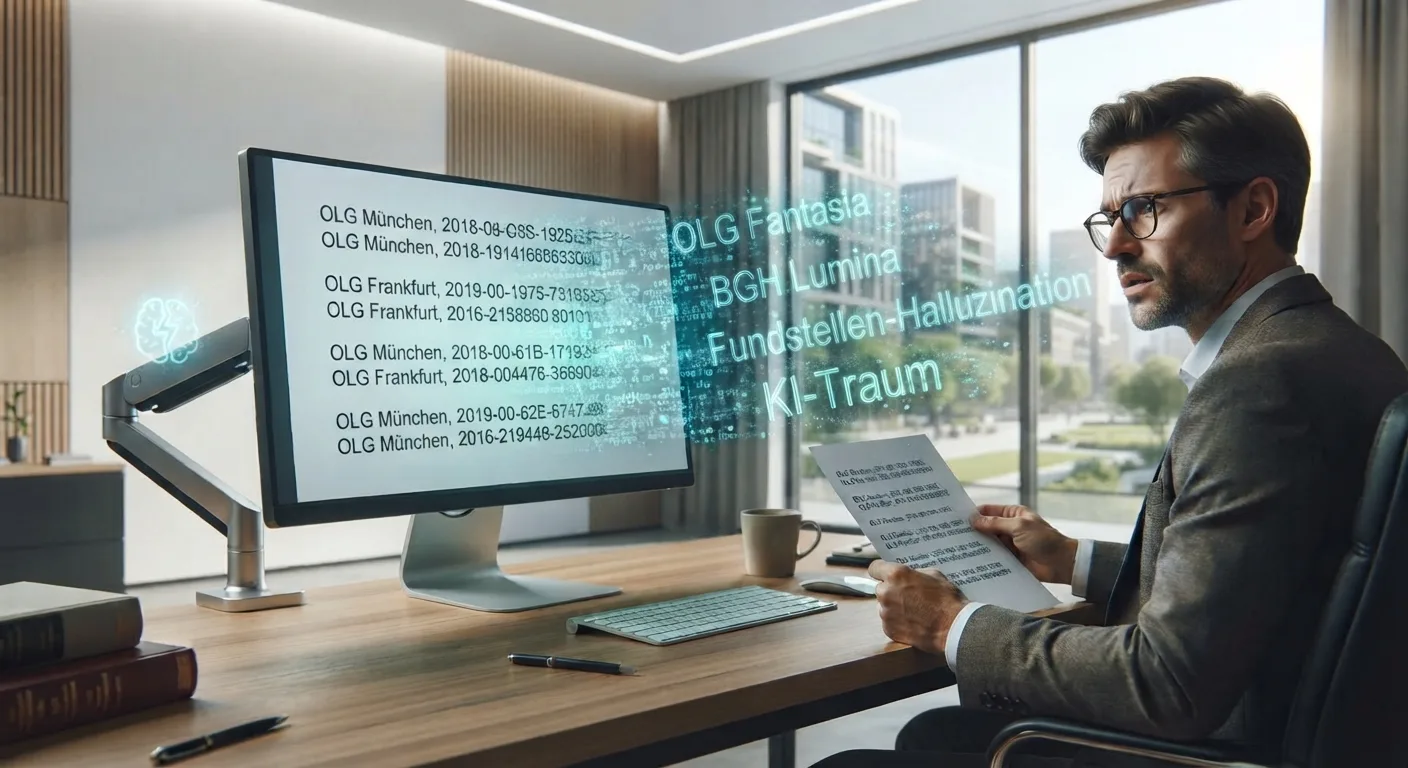
A statement of grounds of appeal cites four decisions of higher regional courts, each with a date and a case number. The panel at the Celle Higher Regional Court enters the details into juris and into beck-online and finds not a single one. In its indicative order of 29 April 2025 (5 U 1/25) it records this four times, each time with the same word: misquotation. The order says nothing about AI. The link to AI hallucinations is drawn by the legal press. For law firms the lesson applies either way: every citation is checked before it goes into a pleading, no matter where it came from.
The case: coaching in Costa Rica
The claimant had booked a programme called the "Costa Rica Masterclass" and paid a deposit of 10,000 euros. According to the defendant, this included a two-week intensive course in Costa Rica and a three-year consultancy project with a six-figure volume. A specialist team was to optimise and build up her business. The claimant terminated the contract and demanded the deposit back. The defendant pointed to its terms and conditions: the deposit was non-refundable.
The Hildesheim Regional Court ruled in the claimant's favour. It found that these were services of a higher nature, which may be terminated at any time, and awarded her repayment. The defendant appealed. Its grounds relied on four decisions of the higher regional courts of Munich, Frankfurt, Düsseldorf and Koblenz. They were meant to show that teamwork and standardised processes do not create a personal relationship of trust. Moreover, long-term consultancy with fixed stages could not be terminated at any time, and businesspeople had to be held to their contracts.
Four misquotations in the pleading
The panel looked for the four decisions and found none. Of the first, it writes that it cannot verify the citation because it is a misquotation. It cannot be retrieved either on juris or on beck-online under the parameters given, that is, by date, case number and citation. For the second it says "again" a misquotation, for the third "here, again, too", for the fourth "here, too". Four citations, four blanks.
The panel says no more than that. It reprimands no one, it imposes no costs, it does not ask where the details came from. It records that it cannot find the decisions and examines the legal question itself on the basis of the case law of the Federal Court of Justice (BGH). For the defendant this meant that the four citations did not help it. But nor did they harm it, because the panel carried on without them.
What the order does not say
The words AI, ChatGPT and hallucination do not appear in the order. The panel says only that it cannot find the decisions under the details given. Who researched the details, and whether a language model was involved, does not appear in the decision. Nor does the order name who wrote the grounds of appeal. Before a higher regional court, however, representation by a lawyer is mandatory.
The link to AI is drawn by the legal press, and the pattern fits: four decisions with a plausible court, a plausible date, a plausible case number and precisely fitting content, none of which can be found. Language models produce details of this kind when they need a citation and do not have one. This is called hallucination. For Celle it is not proven, and part of the legal press points this out itself: misquotations existed before chatbots did. In other cases, for instance before the Kammergericht and the Cologne Local Court, the courts voiced the suspicion of AI themselves. In Celle it remains at the sober finding.
The other side loses anyway
The surprise in the order lies elsewhere. On the panel's provisional assessment, the defendant's appeal will succeed, despite the four misquotations. The reason lies with the claimant. Her own submissions described nothing more than a coaching contract, and the panel regularly does not classify that as services of a higher nature. The attempt to present the course as a package holiday with an easy right of withdrawal also failed, because the contract was primarily concerned with training.
Yet the defendant had supplied the claimant with the arguments itself: a three-year consultancy project, a six-figure volume, optimisation of the business by a team that would inevitably gain insight into its commercial affairs. In the panel's view, anyone who provides something like that is rendering services of a higher nature. The clause making the deposit non-refundable would then be invalid, because it undercuts the right to terminate at any time. The claimant, who was represented by a lawyer, could have adopted these submissions in the alternative; the Federal Court of Justice allows this in its settled case law. Instead she expressly denied them. On her own submissions, the claim was not made out. How the proceedings continued after the three-week period for comment does not appear from the order.
Check citations, whatever the source
For small law firms, the lesson lies in the panel's method. It did not speculate about where the citations came from. It entered the date, case number and citation into two databases. Precisely this check belongs before every pleading goes out, for every citation: from the database, from an old pleading, from an article, from the client, from a member of staff or from a chatbot. The court does not distinguish by source. Either it finds the decision or it does not.
Two steps are enough. First: every decision cited is retrieved by date and case number. Anything that cannot be found is deleted. Second: anything that can be found is read, because the court will examine the content itself anyway, in Celle on the basis of the Federal Court of Justice. It makes sense to allocate fixed responsibility for this, for instance so that whoever signs the pleading ticks off the citations. The effort amounts to a few minutes per citation. The Celle order, by contrast, remains permanently in the Lower Saxony case law database, with all four misquotations.
And the case shows something else: what tipped the balance was not a citation but a craftsmanship error in the factual submissions. If you fail to adopt the other side's favourable submissions in the alternative, you will lose even with clean citations.
Conclusion
The Celle Higher Regional Court looked for four citations from a statement of grounds of appeal and found none. The order says no more than that: no reprimand, no speculation about the source, not a word about AI. The attribution to AI hallucinations comes from the legal press and fits the pattern, but remains speculation.
For law firms that changes nothing. A court checks the date, the case number and the citation, and that check belongs in the firm beforehand, for every citation from every source. What tipped the balance in Celle, on the panel's provisional assessment, was an error in the other side's factual submissions.