Legal Tech
Invented citations: what courts hold against lawyers using AI
Tobias Reinhardtapprox. 6 min read
A pleading cites a Federal Court of Justice (BGH) decision that never existed. In 2025, the Kammergericht, Berlin's higher regional court, reprimanded a lawyer for precisely that, and the Cologne Local Court and the Frankfurt Regional Court had already commented clearly on similar cases before. Why an AI hallucination in a pleading is no excuse, and what checks courts expect from law firms.
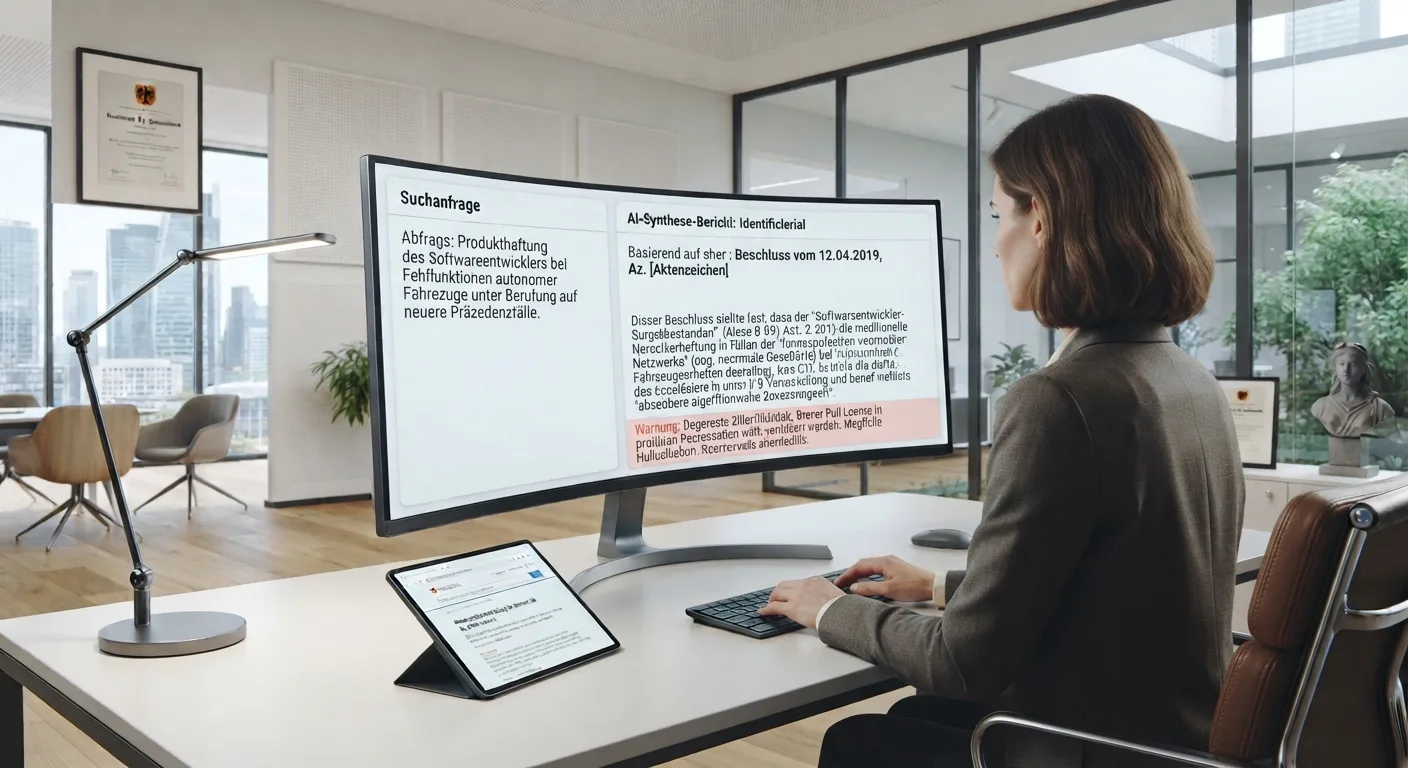 AI-generated
A notice of appeal relied on a ruling by the Federal Court of Justice, complete with date, case number and citation in FamRZ. The only problem: that ruling does not exist. By order of 20 November 2025 (17 WF 144/25), the Berlin Court of Appeal (Kammergericht) issued a formal reprimand to the lawyer concerned. Its guiding principle: anyone who drafts pleadings with AI must check them, above all the citations.
Cologne Local Court and Frankfurt Regional Court had already commented pointedly on similar pleadings. All three courts say the same thing: a hallucination, that is, a plausible-sounding but entirely invented statement by the AI, does not excuse the lawyer.
The case before the Court of Appeal
A mother applied in urgent proceedings for parental custody of her daughter, claiming that the father posed a risk to the child's welfare. The Berlin-Kreuzberg Local Court saw no urgency and also refused legal aid for the proceedings. The mother's lawyer lodged an immediate appeal. The pleading relied on a 2007 ruling of the Federal Court of Justice and a 2016 ruling of the Brandenburg Higher Regional Court.
The senate could find neither, either in the legal databases or on the Federal Court of Justice's website. By its own account, it searched extensively and found only one Federal Court of Justice decision, with a different date, case number and content. The citations were evidently the product of a "fantasising" AI. The appeal was unsuccessful.
AI hallucination: the duty to check remains
The Court of Appeal added to its dismissal a precautionary note to the lawyer, reprimanding in tone. In the senate's view, lawyers are under a professional obligation to check citations, both because of the client relationship and because of their position as officers of the administration of justice. The use of AI changes nothing in this respect. As the guiding principle puts it: pleadings drafted with AI must be checked, in particular as to whether the case-law citations are the product of a fantasising AI.
Whether the lawyer admitted using AI is not known. The senate inferred the use of AI from the citations themselves.
Cologne: books that do not exist
Sitting as a family court, Cologne Local Court had a similar pleading before it as early as 2 July 2025 (312 F 130/25), this time from the respondent's representative. He cited requirements that did not appear in the decision referred to, along with books that do not exist, misattributed authors and citations that led nowhere. The court considered this to have been apparently generated by artificial intelligence and entirely invented.
The judge went further than the Court of Appeal later did. He called on the lawyer to refrain from such submissions in future. Citations of this kind made it harder to establish the law and damaged the reputation of the legal profession. He also referred to the professional prohibition on knowingly spreading untruths. Professional conduct expert Volker Römermann has disagreed: someone who relies on an AI without checking is not knowingly lying, any more than someone relying on an unreliable trainee. Professional supervision lies with the bar associations, and a court order is no place for instructions to lawyers.
Frankfurt: the court asks the AI itself
On 25 September 2025 (2-13 S 56/24), Frankfurt am Main Regional Court had only to decide the value in dispute of a removal claim in a residential property case. Counsel for the claimant argued with verbatim quotations from the Federal Court of Justice. Citation, date and case number: all wrong, and the chamber spoke of a "complete fabrication". The genuine quotations in the pleading concerned the amount of the grievance, a different question altogether.
The chamber then put the legal question to several AI chatbots itself. The answers were faultless: the value in dispute is determined by the loss in value, not by the cost of removal. So the technology could have managed it. The court counted it among the basic duties of legal practice not to invent citations and to check AI-generated citations in full text beforehand. A court must be able to trust a lawyer's citations, otherwise the administration of justice suffers. And it expressly hoped that a chatbot had hallucinated the fabrications and not the lawyer himself.
Expert witnesses and a look at London
By order of 10 November 2025 (19 O 527/16), Darmstadt Regional Court reduced a medical expert's fee from 2,374.50 euros to nothing. The professor had not examined the claimant and had answered the court's questions without giving reasons. The court identified patterns typical of AI: repeated wording, almost nothing but main clauses with the same opening, and phrasing that read like instructions on how to process the prompt, that is, the input given to the AI. The expert had not disclosed that he was unable to prepare the report personally, and it was unusable.
How serious this can become is shown by the High Court in London in its judgment of 6 June 2025, case number [2025] EWHC 1383 (Admin). A barrister had cited five non-existent decisions. In a second case, 18 of 45 citations were entirely invented, researched by the client using AI and adopted by the solicitor without checking. The court imposed costs sanctions and referred those involved to their regulators. Freely available AI tools such as ChatGPT are not capable of reliable legal research, and the duty to check also applies to anyone relying on research carried out by others. A reprimand alone is not sufficient except in exceptional cases.
What this means for law firms
No court prohibits the use of AI. All of them require the lawyer to check the output before it goes out under their name. On the basis of these decisions, that check has four stages:
- Existence: the decision must be traceable in a database or on the court's website.
- Content: the decision must say what the pleading claims it says. Frankfurt Regional Court requires the full text for this. In Cologne, the requirements cited came from a decision that did not contain them.
- Fit: the decision must concern the right question. In Frankfurt, even the genuine quotations failed on this point.
- Source: the duty applies regardless of who did the research, whether client, staff member or chatbot.
Anyone using AI in a law firm needs a firm rule: nothing leaves the building before a lawyer has looked up every citation and read the text. That takes time, but less than a senate conducting an extensive search and ultimately publishing its reprimand.
Conclusion
The Court of Appeal has confirmed what Cologne Local Court and Frankfurt Regional Court had already warned about: a pleading produced by AI is a draft, and responsibility for every citation remains with the lawyer. A hallucination is no excuse, because checking a database takes only a few minutes.
In Germany, matters have so far gone no further than a reprimand, a request to desist and public exposure, and whether professional conduct rules apply is contested. The High Court in London is already reaching for costs and professional regulators.












