Employment law
Pregnant after dismissal: the medical finding is what counts
Tobias Reinhardtapprox. 6 min read
An employee only learns that she is pregnant after her dismissal, by which time the deadline for filing a claim has already passed. The Federal Labour Court (BAG) nevertheless allows her claim, because certainty only comes with a medical examination and a self-test is not enough. What this means for a dismissal during pregnancy and what matters afterwards.
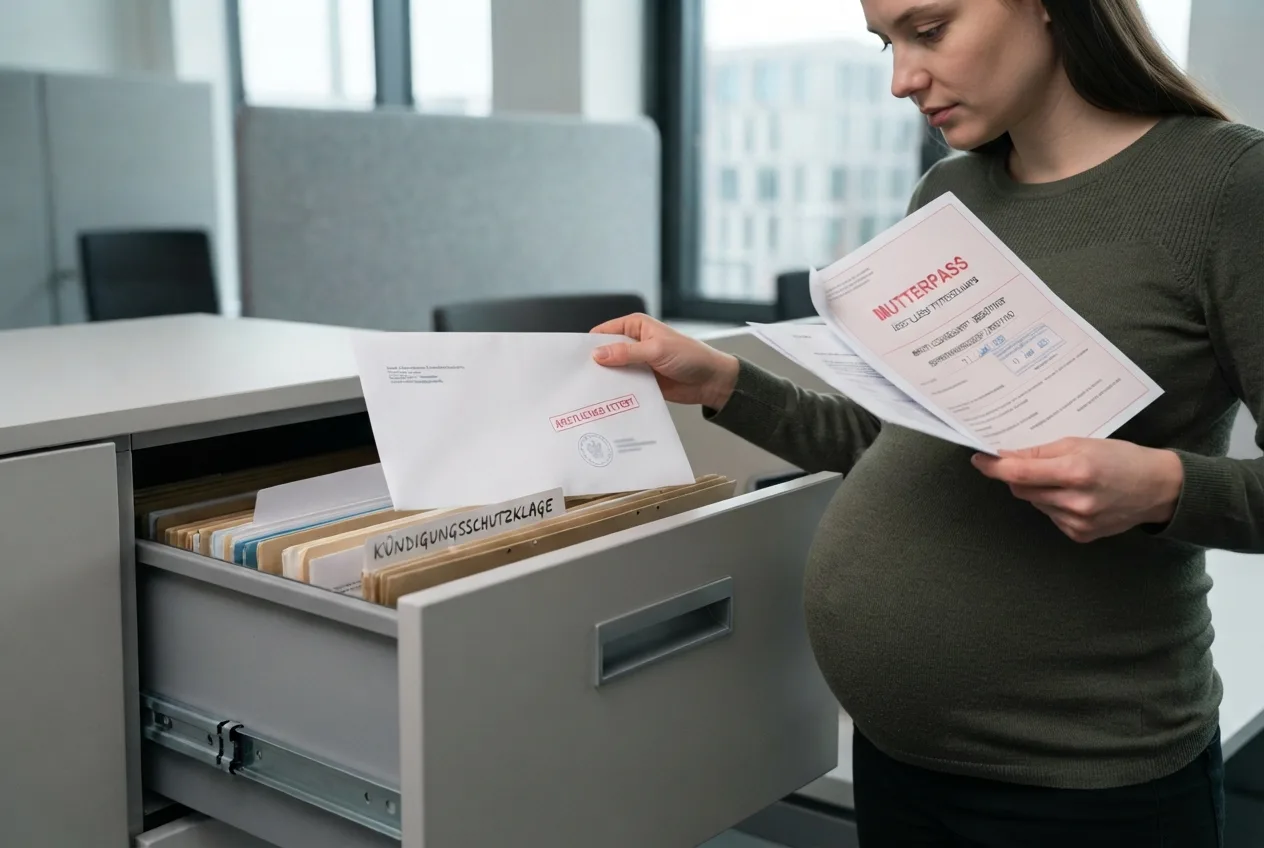 AI-generated
Dismissal during pregnancy: the case
A dismissal of a pregnant employee is, as a rule, invalid. But this protection is only of use if the woman brings her claim in time, and after a dismissal there are only three weeks in which to do so. What applies where the pregnancy is not medically confirmed until after that deadline has expired has now been clarified by the Federal Labour Court (BAG) in its judgment of 3 April 2025 (2 AZR 156/24). The late claim must be admitted retrospectively. A positive self-test within the deadline does not change this, because it does not yet provide reliable knowledge.
The employee received a letter of dismissal on 14 May 2022, by which the employer gave ordinary notice terminating the employment relationship with effect from 30 June 2022. On 29 May 2022 she took a pregnancy test, which was positive. She immediately tried to get an appointment with her gynaecologist, but only obtained one for 17 June 2022. There the pregnancy was confirmed. Her maternity record gave 2 February 2023 as the expected date of birth. Calculating backwards, the pregnancy had therefore begun on 28 April 2022, a good two weeks before the dismissal.
The limitation period had already expired
Anyone wishing to challenge a dismissal must bring a claim before the labour court within three weeks of receiving the letter of dismissal. That is the limitation period for bringing a claim. Here it ended on 7 June 2022. The employee, however, only filed her unfair dismissal claim on 13 June 2022, together with an application for retrospective admission. She submitted the medical certificate confirming the pregnancy afterwards, on 21 June 2022.
Missing the deadline has harsh consequences: the dismissal is then deemed effective, even if it would not otherwise have been. There is a special rule on when the period starts if the dismissal requires the approval of a public authority. In that case the period only begins once the employee is aware of the authority's decision. That did not help here, because the employer knew nothing of the pregnancy at the time of the dismissal. The period therefore began in the normal way when the letter was received.
The exception: retrospective admission of the claim
The law provides an exception for precisely this situation: retrospective admission of the claim. On application, the labour court will admit a late claim where a woman learned of her pregnancy, through no fault of her own, only after the limitation period had expired. The dispute therefore turned on a single question: when did the employee learn of her pregnancy?
The employer argued: on 29 May 2022, with the positive test. At that point there was still a good week left of the limitation period. The employee could therefore have brought her claim in time, and the exception did not apply. The labour court and the Saxony Regional Labour Court took a different view and upheld the claim. The employer then appealed to the Federal Labour Court.
Why the self-test was not enough
The Federal Labour Court dismissed the employer's appeal. The dismissal is invalid because it breaches the prohibition on dismissal under the Maternity Protection Act. The late claim had to be admitted retrospectively. The employee only gained reliable knowledge that she had already been pregnant when the dismissal was received at the earliest possible gynaecological examination on 17 June 2022.
In the court's view, the self-test of 29 May 2022 could not give her this knowledge. Two things mattered: that she was pregnant, and that she had already been so on 14 May 2022. The special protection against dismissal only applies if the pregnancy already existed when the dismissal was received. That was established only by the medical examination and by calculating back from the expected date of birth.
The court also considers that this interpretation satisfies the requirements of European law. In 2024, in the „Haus Jacobus“ case, the European Court of Justice set out requirements for the protection of pregnant employees. In the Federal Labour Court's view, the German interplay of limitation period, retrospective admission and prohibition on dismissal meets those requirements.
What the judgment means for pregnant women
Anyone who receives a dismissal and only afterwards learns of the pregnancy does not lose protection simply because the three weeks have passed. It remains a precondition that the pregnancy already existed when the dismissal was received. The way back into the proceedings is via the application for retrospective admission. What matters is the point in time of the medical confirmation. A self-test alone does not yet provide the knowledge that counts. This takes the pressure off those affected to bring a claim immediately after a positive test without being able to prove the pregnancy.
The flip side is just as important. The court emphasises that the employee immediately sought an appointment and attended the earliest possible examination. The exception only applies where the woman is not herself responsible for the delayed knowledge. Anyone who, after a positive test, fails to arrange a doctor's appointment for weeks will scarcely be able to rely on it.
After a positive test: next steps
The decision sets out a clear course of action where a pregnancy test is positive after a dismissal:
- Arrange a doctor's appointment immediately, and the earliest one available. That is precisely what the court relied on.
- Do not put off the unfair dismissal claim. The employee in the decided case filed it before she had even seen the doctor and submitted the medical certificate later.
- File the application for retrospective admission together with the claim. Without this application the late claim remains inadmissible. A deadline also applies to the application, running from the moment the obstacle falls away.
- Submit the medical certificate as soon as it is available. It proves the pregnancy and, via the calculated date of birth, also that it already existed when the dismissal was received.
Conclusion
A dismissal during pregnancy is invalid, and this protection is not lost merely because the pregnancy is only medically confirmed after the limitation period has expired. According to the Federal Labour Court, reliable knowledge is provided only by the medical examination; a positive self-test is not enough.
Anyone who learns of a pregnancy after a dismissal would do best to arrange a doctor's appointment straight away. The claim, together with the application for retrospective admission, should go to the labour court without delay, with the medical certificate submitted afterwards. The wait for the earliest possible appointment is then not held against the employee.












