Employment law
No waiver of statutory minimum holiday in a court settlement
Tobias Reinhardtapprox. 6 min read
Settlement agreements on termination deal with the dismissal, the severance payment and holiday entitlement in one go. For the statutory minimum holiday, this does not work while the employment relationship is still in place. In 2025, the Federal Labour Court (BAG) held that the clause "holiday entitlements have been granted in kind" does not exclude payment in lieu, even if the employee was unable to work throughout.
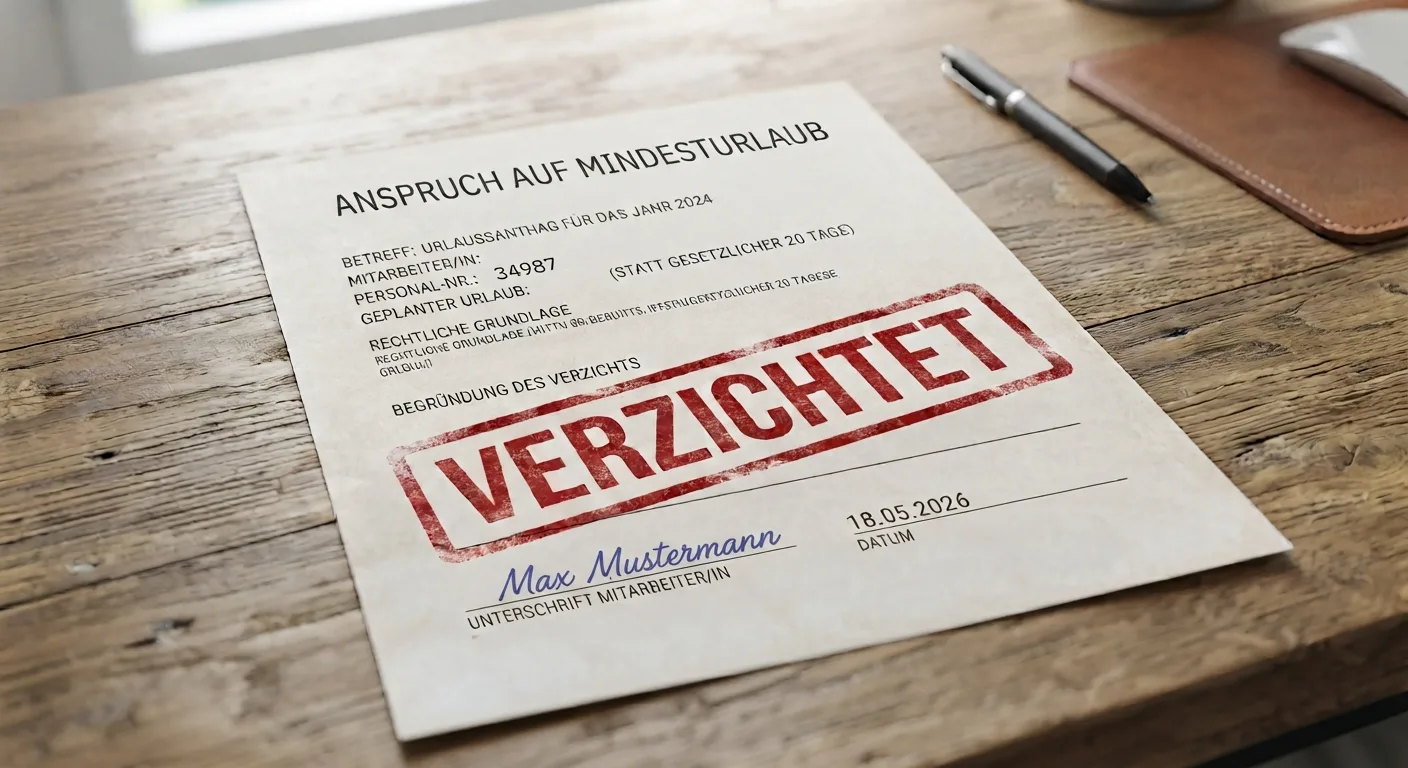 AI-generated
The case: clause 7 of the settlement
A termination settlement is meant to draw a line. Dismissal, severance and holiday are dealt with, and afterwards neither side should be able to claim anything further. Where the statutory minimum holiday entitlement is concerned, that calculation does not work out as long as the employment relationship is still in existence. The Federal Labour Court (BAG) made this clear in its judgment of 3 June 2025 (case number 9 AZR 104/24): during an ongoing employment relationship, an employee cannot waive their minimum holiday entitlement, not even by way of a court settlement. A clause stating that the holiday has been granted is of no help to the employer.
The claimant had been employed as an operations manager since 1 January 2019. Throughout 2023 he was continuously unfit for work from the outset and was unable to take his holiday. On 31 March 2023 the parties reached an agreement in court: the employment relationship would end by employer's dismissal with effect from 30 April 2023, and the employer would pay severance of 10,000 euros. Clause 7 of the settlement read: "Holiday entitlements have been granted in kind."
The background is remarkable. Before the settlement was concluded, the claimant's legal representative had expressly pointed out that the statutory minimum holiday entitlement cannot effectively be waived. She subsequently agreed to the settlement anyway, while referring to those reservations. After leaving, the claimant demanded payment in lieu of seven days of minimum holiday from 2023, a total of 1,615.11 euros plus interest. Both lower courts found in his favour, most recently the Regional Labour Court of Cologne.
What the BAG decided
The Ninth Senate dismissed the defendant's appeal on points of law, apart from a minor part of the interest claim. The claimant is entitled to payment in lieu of his unfulfilled minimum holiday from 2023; clause 7 of the settlement did not extinguish that claim. The agreement is invalid in so far as it excludes the statutory minimum holiday entitlement. According to the Senate, the prohibition in § 13 Abs. 1 Satz 3 BUrlG covers the holiday entitlement itself and equally the claim for payment in lieu, which only arises upon legal termination. Neither may be excluded or restricted in advance.
This applies even where, at the time the settlement is concluded, it is already clear that the employee will no longer be able to take the holiday because of illness. The Senate relies on the Working Time Directive: paid minimum holiday may not be replaced by money except on termination of the employment relationship. During an ongoing employment relationship, the employee may therefore not waive the minimum holiday entitlement in return for financial compensation, and all the less so without it.
Not a settlement on the facts
The Senate also examined whether clause 7 amounted to a settlement on the facts. The prohibition would not apply to such a settlement. A settlement on the facts requires the parties to wish to resolve an existing uncertainty about the factual requirements of a claim by mutual concession. That was absent here, because the claimant had been continuously unfit for work since the beginning of 2023, so no holiday can have been granted at all that year. There was no room for any uncertainty about the factual requirements of the holiday entitlement.
The wording "have been granted in kind" sounds like a statement of fact. In substance, according to the Senate, it provided for an exclusion of the minimum holiday entitlement. Dressing it up as a fact changes nothing where the facts are undisputed.
Good faith is no help
The defendant also argued that, in good faith, the claimant should not be allowed to rely on the invalidity. Given the background, the argument was an obvious one: the claimant's lawyer had raised the reservations before the settlement and then concluded it anyway. The Senate did not accept this. The defendant was not entitled to rely on the validity of a plainly unlawful provision.
For employers, that is the uncomfortable part of the judgment. The written warning from the other side gave rise to no protection of legitimate expectations before the court. For the claimant, by contrast, his lawyer's approach paid off: reservations put in writing, settlement concluded, payment in lieu claimed later and won.
Consequences for settlement practice
The judgment affects the classic termination settlement with a run-off period. If the settlement is concluded before the termination date, the employment relationship still exists. The claim for payment in lieu only arises upon legal termination. Any provision that excludes or reduces it beforehand is an exclusion in advance and, as regards the minimum holiday entitlement, invalid. In the case decided, one month lay between the settlement and the termination.
The invalidity extends only so far as the clause concerns the statutory minimum holiday entitlement. The Senate's reasoning does not automatically apply to holiday beyond that. Nor does the idea of simply pricing the holiday into the severance payment work for the minimum entitlement. During an ongoing employment relationship, according to the Senate, a waiver is ruled out even in return for money.
Minimum holiday: what works in a settlement
Two routes emerge from the reasoning. The first is the settlement on the facts. It remains possible where it is open whether and to what extent holiday was granted, for example where holiday records are incomplete. For an employee who has been ill throughout, this route is ruled out, because there is nothing the parties could be uncertain about.
The settlement should then expressly name the uncertainty and the mutual concession, for example as follows: "It is in dispute between the parties to what extent the employee was granted holiday in 2025. In order to resolve this uncertainty, the parties establish, by mutual concession, that five days of holiday remain outstanding." Without such an uncertainty, it remains a waiver, and that is invalid.
The second route is payment in lieu, which the Working Time Directive expressly permits on termination of the employment relationship. Anyone who counts the outstanding minimum holiday as at the termination date and pays the correct amount in lieu in the settlement has dealt with the issue. A flat-rate amount below the statutory figure, by contrast, would again be a restriction in advance. The usual release from work with set-off against remaining holiday does not help in the case of an employee who is unfit for work, because they cannot take the holiday.
Conclusion
During an ongoing employment relationship, the statutory minimum holiday entitlement cannot be negotiated away, not even in court and not even in the case of a permanently ill employee. The clause "holiday entitlements have been granted in kind" only holds up as a genuine settlement on the facts, and that requires real uncertainty about the facts.
For the termination settlement, this means: count the outstanding minimum holiday and pay it in lieu as at the termination date or, where the facts are in dispute, name the uncertainty and the mutual concession in the settlement. If the other side points out the invalidity in correspondence, that is the right moment to amend the clause.












