Employment law
Sick note from the internet: summary dismissal valid
Tobias Reinhardtapprox. 6 min read
An IT consultant submits a sick note he bought online by filling in a questionnaire. No doctor spoke to him, neither in person nor by phone nor by video. The Regional Labour Court of Hamm holds the summary dismissal to be valid, without any prior warning, and explains why such an online sick note amounts to deceiving the employer and what companies can take from this for their own practice.
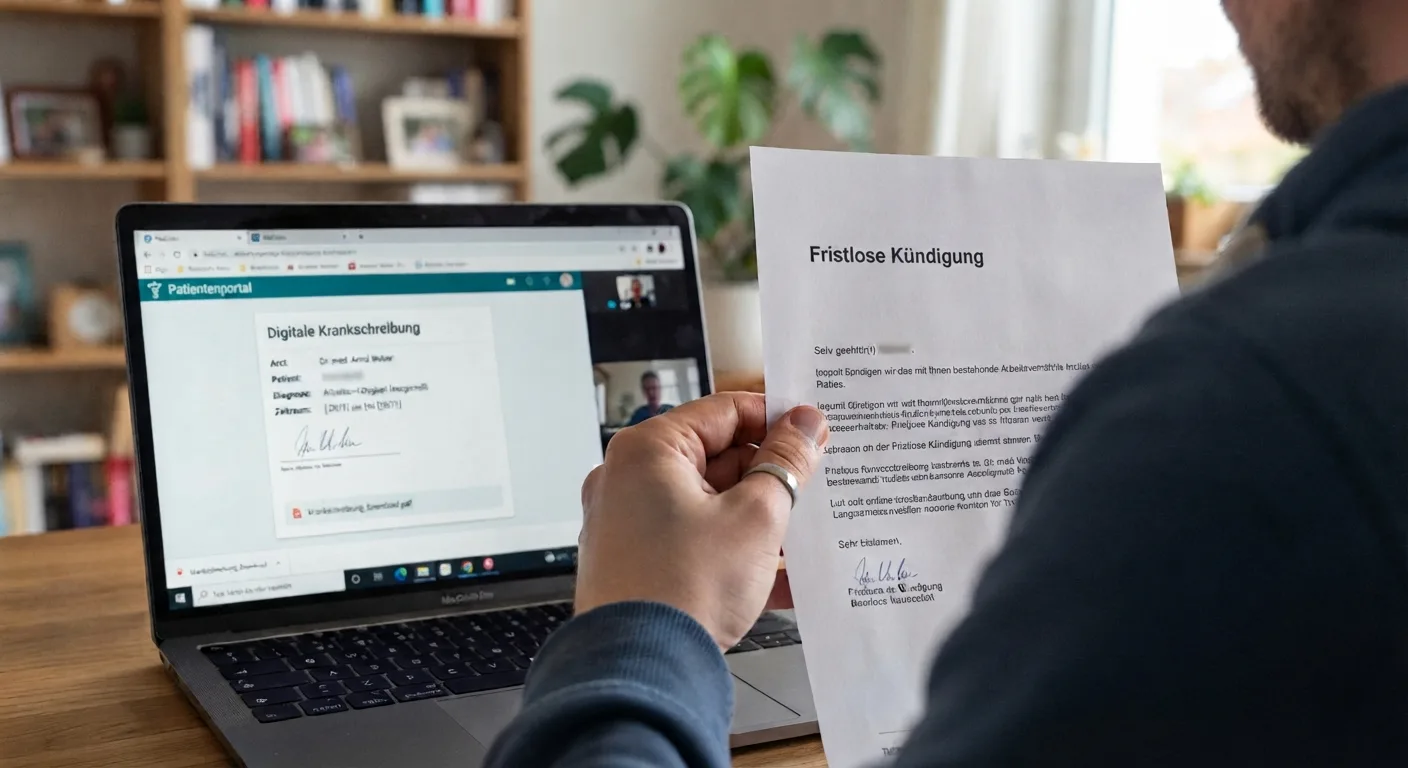 AI-generated
The case: an online sick note without a doctor
Anyone who buys a sick note online without a doctor being involved risks summary dismissal. That is what the Hamm Regional Labour Court (LAG) decided in its judgment of 5 September 2025 (14 SLa 145/25). No prior warning was required, and whether the employee was genuinely ill made no difference.
The employee, who had been with the company since 2018 and most recently worked as an IT consultant, called in sick for five days in August 2024. On a website he filled in a questionnaire with pre-set answers, ticked malaise, a dry cough and aching limbs and back pain, and paid a fee. A few hours later a certificate of incapacity for work landed in his inbox, the document employees use to prove their illness. There was no contact with a doctor, neither in person nor by telephone nor by video.
The certificate looked like the old yellow slip. The text, however, said “remote examination by questionnaire only”. In the field for the doctor's stamp there was a “private doctor via telemedicine”, a WhatsApp number and an email address. The employee uploaded the document to the HR system, received the message “approved” and continued to be paid his salary for the days of illness.
How the deception came to light
About three weeks later the absence management department grew suspicious. The doctor named could not be traced, and no digital sick note had been received through the electronic data exchange with the health insurer. On 13 September 2024 the department reported the suspected forgery to HR. After an internal review, the board member responsible learned of the matter on 17 September. On the same day the employee's manager spoke to him about booking the days of illness as holiday instead of reclaiming the salary. A day later the company dismissed him without notice, and in the alternative with notice. The letter reached the employee on 23 September 2024.
The provider itself made no secret of the situation. Its website stated that the cheaper “sick note without a consultation” carried less evidential weight in court than the version with a doctor's consultation. The doctors issuing the certificates worked abroad and were not registered with any German medical association. Customers were therefore advised to ask their employer straight away whether the certificate was “OK as is”.
First instance: a warning would have been enough
The employee challenged the dismissal. He said he had genuinely been ill, had relied on the certificate and had agreed a solution with his manager using holiday days. He also argued that the company had missed the two-week deadline that applies to summary dismissals once the employer knows the facts. The Dortmund Labour Court found in his favour on 8 January 2025. He had indeed breached his duty to produce a proper certificate. But the company should first have issued him with a formal warning, that is, formally told him that a repetition would result in dismissal. The company had not shown that he was not ill at all.
LAG Hamm: a breach of trust without a warning
The Regional Labour Court dismissed the claim. The employee had deliberately created the impression that a doctor had established his incapacity for work after an examination. The word “remote examination” suggested a conversation with a doctor, and the addition “by questionnaire only” did not change that. The presentation as a yellow slip also signalled that everything had followed the usual medical rules. Under those rules a doctor may only certify incapacity for work after an examination, whether in person, by video or after a telephone call. The employee knew this, because the website had told him so itself.
Whether he was ill was irrelevant. The breach of trust lay in the deception about how the certificate had come about. That weighed particularly heavily because an employer has no insight into how a sick note is issued and has to rely on the document. An employer need not accept such a serious, deliberate breach of duty even on the first occasion, so a warning was unnecessary. In addition, the evidential value of the certificate was undermined, meaning it was no longer sufficient in court as proof of illness. The employee would then have had to set out precisely why he had been unable to work on each individual day. Instead he merely listed symptoms and medication.
The employee's objections failed
The two-week deadline was met. It starts as soon as a person authorised to dismiss has reliable knowledge of the facts. Here that was 17 September 2024, and the dismissal arrived on 23 September. Even counting from 13 September, when HR was informed, there was still time.
The “approved” message did not help the employee either. According to the company's uncontested submission, the system was merely confirming receipt of the file. The court did not read any waiver of rights into it. In the court's view, the arrangement about holiday days governed only the payment for that period. The company had not thereby waived its right to dismiss.
Online sick notes: what employers should do
The judgment carries three messages for companies. First: sick notes issued by video or telephone are permissible, sick notes issued by questionnaire without a doctor are not. Indications such as “private doctor via telemedicine”, a WhatsApp number in the stamp field or the wording “remote examination by questionnaire only” are reason to look more closely. A cross-check against the electronic sick note held by the health insurer shows whether a certificate exists there at all.
Second: the two-week deadline runs from the knowledge of the person entitled to dismiss. A suspicion therefore belongs on that person's desk without detours, and the dismissal must be served promptly. In this case ten days passed between the first suspicion and receipt.
Third: side agreements and automated system messages remain tricky. The arrangement about holiday days only failed to harm the company because the court interpreted it narrowly. Anyone offering such a settlement should record that it does not decide anything about further steps. And an “approved” after an upload sounds like consent, even if it merely confirms receipt. The LAG Hamm expressly describes its judgment as a decision on the individual case and did not allow an appeal on points of law. Anyone planning to dismiss in a similar case should document every step as carefully as the company did here.
Conclusion
A sick note bought by questionnaire without any contact with a doctor amounts, in the view of the LAG Hamm, to deceiving the employer. Such a certificate justifies summary dismissal even without a prior warning, regardless of whether the employee was ill.
Two things matter for employers: check suspicious certificates and pass the suspicion quickly to the person entitled to dismiss.