Employment law
Sick notes from outside the EU: when doubts are enough
Tobias Reinhardtapprox. 6 min read
A warehouse worker on holiday sends in a medical certificate stating 24 days of incapacity for work along with a ban on travelling – and books the ferry home the next day. The Federal Labour Court (BAG) has set out when the evidential value of a sick note issued abroad is undermined: when several circumstances, each harmless in itself, together give rise to serious doubts. For employers, this means gathering the irregularities and presenting them as an overall picture.
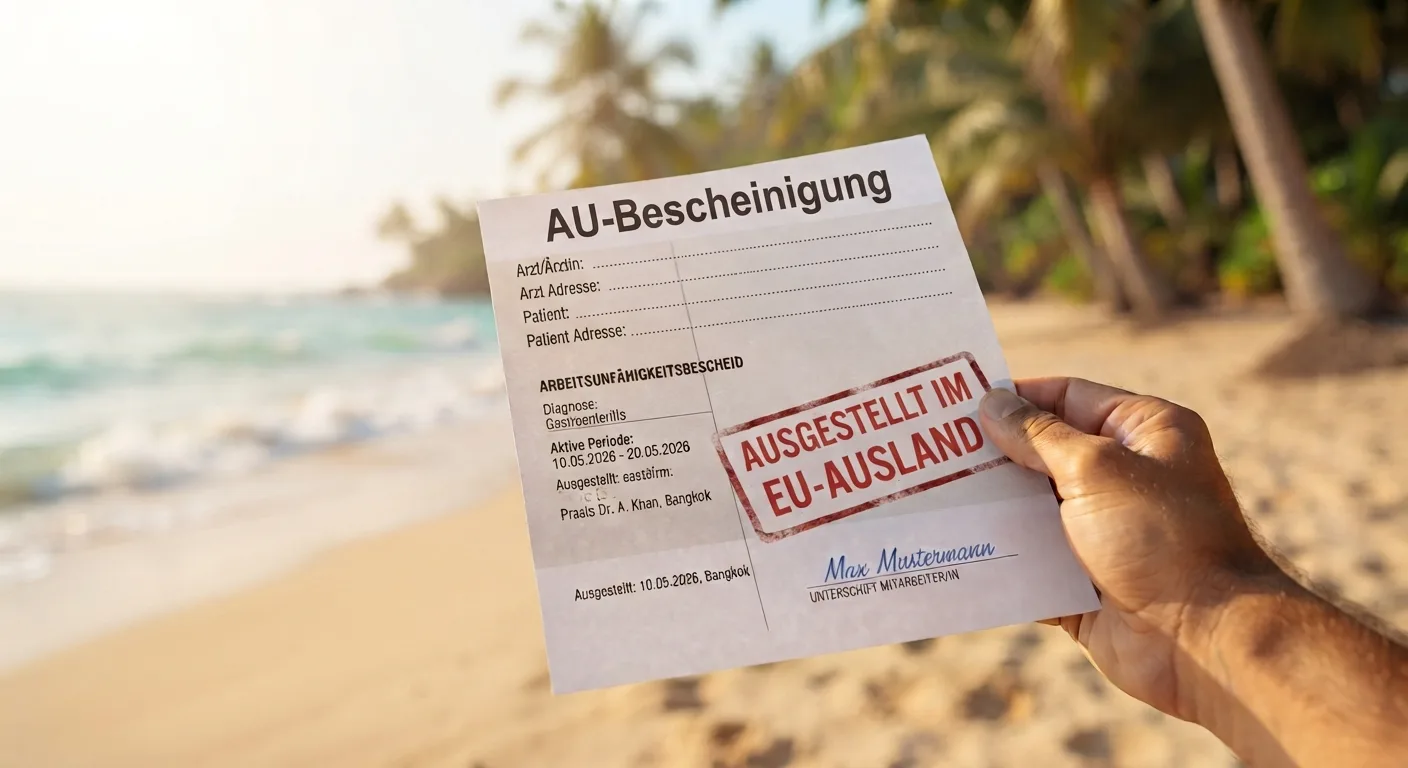 AI-generated
The case: ill on holiday
A medical certificate issued in a country outside the EU has, in principle, the same evidential value before German labour courts as a German one. But it can be called into question in the same way: by circumstances that look harmless on their own and only together give rise to serious doubts. That is what the Federal Labour Court (BAG) decided in its judgment of 15 January 2025 (5 AZR 284/24). The case involved a certificate obtained during a holiday, a ban on travelling and a ferry ticket that the patient booked a day later.
The claimant has worked as a warehouse operative for the defendant since 2002, most recently for an average gross salary of 3,612.94 euros per month. From 22 August to 9 September 2022 he was on holiday, which he spent in Tunisia. On 7 September he emailed his employer to say that he had been signed off sick until 30 September. Attached was a certificate from a Tunisian doctor dated the same day, written in French. According to the certificate, the man was suffering from severe sciatic pain in the lumbar spine and needed 24 days of strict rest at home. During that time he was to neither move about nor travel.
Ferry booked, pay reduced
One day after the visit to the doctor, on 8 September 2022, the claimant booked a ferry ticket for 29 September. On that day he got into his car, took the ferry from Tunis to Genoa and drove on to Germany. He subsequently produced an initial certificate from a German doctor dated 4 October, certifying incapacity for work until 8 October.
The employer refused continued payment of remuneration and reduced the September pay by 1,583.02 euros net. The warehouse operative sued for that amount. The labour court dismissed the claim; the Munich Regional Labour Court awarded him the money. Before the Fifth Senate of the Federal Labour Court, the employer's appeal on points of law succeeded.
What it means to call evidential value into question
In disputes about continued payment of remuneration, the certificate of incapacity for work is the employee's most important piece of evidence. Courts initially assume that it is correct. Lawyers speak of its high evidential value. The employer can call this evidential value into question by setting out circumstances that raise serious doubts about the certified incapacity for work. If he succeeds, the certificate no longer serves as proof. The employee must then set out and prove himself that he was ill and therefore unable to work. Without that proof, there is no continued payment of remuneration.
Same evidential value as at home
The Federal Labour Court first confirms the starting point taken by the lower court. A certificate from a country outside the European Union has, in principle, the same evidential value as a German one. The condition is that it shows that the foreign doctor distinguished between mere illness and an illness that results in incapacity for work. Someone with a cold is ill but can often still work. The certificate must therefore say more than "the patient is ill".
The place of issue alone therefore makes no difference to the evidential value. According to the Federal Labour Court, the same principles apply to calling it into question as with a certificate issued in Germany. Anyone who doubts a certificate merely because of the foreign stamp will fare badly in court.
Overall assessment instead of item-by-item review
The lower court's mistake lay in its method. The Regional Labour Court had looked at each circumstance put forward by the employer in isolation and considered each of them innocuous. The overall assessment required by law was missing. The Federal Labour Court carries it out and names three points.
First, the Tunisian doctor certified 24 days of incapacity for work in one go, without arranging a follow-up appointment. Second, just one day after the doctor had forbidden him to move about or travel, the claimant booked the ferry for 29 September and set off on the long journey home on that day. Third, in the years 2017 to 2020 he had three times produced a sick note immediately after his holiday. Each point on its own may have a harmless explanation. Together they give rise to serious doubts about the evidential value of the certificate.
The claimant therefore now bears the full burden of setting out and proving his incapacity for work. Because the Regional Labour Court had made no findings on this, it must hear the case again. Whether the man really was unfit for work in September 2022 is something it has yet to clarify.
Checking a sick note from abroad
For HR departments, the judgment provides an order in which to check things. The first look is at the certificate itself: does it show that the doctor established incapacity for work and not just an illness? The language of the document is no obstacle here. The certificate in the decided case was in French, and the Federal Labour Court had no issue with that.
The second look is at the surrounding circumstances. The judgment shows what can matter: a long period of sick leave without a follow-up appointment, travelling despite a ban on travel, sick notes that repeatedly follow on directly from a holiday. Such points should be documented, with dates and evidence. Anyone wishing to refuse continued payment of remuneration should present them in court as an overall picture and expressly ask the court to assess them in context.
Two limits remain. The country of origin is not an argument; the doubts must arise from the specific case. And calling the certificate into question only shifts the burden of proof. If the employee manages to prove his illness by other means, the employer must pay the withheld remuneration. Anyone reducing pay should be aware of that risk.
Conclusion
A certificate from a non-EU country is worth as much as a German one, provided the doctor has clearly distinguished between illness and incapacity for work. It can be called into question under the same rules: by circumstances that may be innocuous on their own and together give rise to serious doubts.
For employers this means: collect the irregularities, back them up with dates and present them as an overall picture. The employee must then prove that he really was ill.












