Artificial intelligence
AI essay in an application: university may refuse the master's place
Tobias Reinhardtapprox. 6 min read
An applicant for a master's programme at TU München submitted an essay that detection software classified as 71 per cent AI-generated text. The university excluded him from the application process, and the Administrative Court of Munich held this to be lawful. What makes the decision worth reading is above all how the examiners spotted the AI, and why the software's figure was only the starting point.
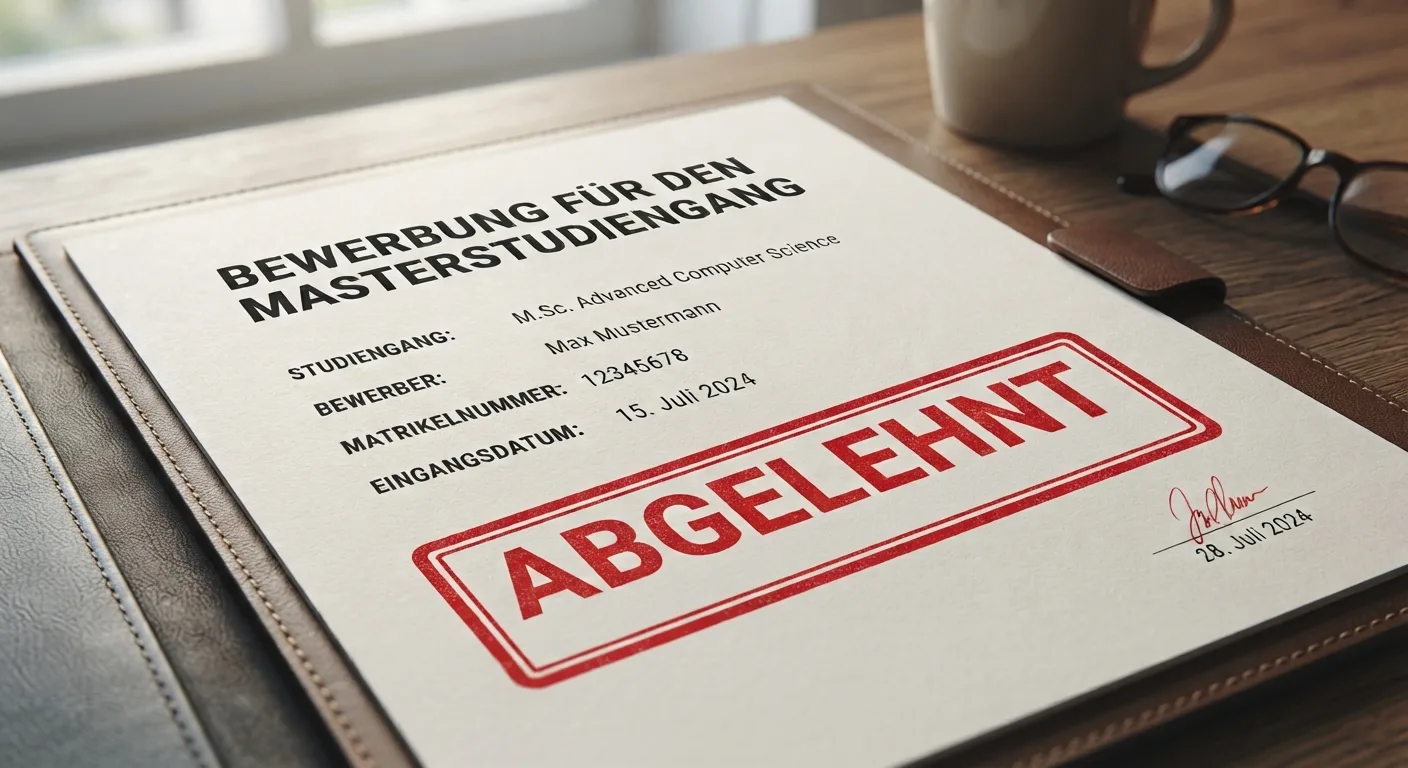 AI-generated
No place on the course after an AI essay
An applicant for the master's programme "Management and Technology" at the Technical University of Munich did not get his place. The Administrative Court of Munich rejected his urgent application by decision of 8 May 2024 (case reference M 3 E 24.1136). In the examiners' view, his application essay had largely been written by an AI, even though he had ticked a box confirming the opposite. In the court's opinion, anyone who submits such an essay breaches the rules of good academic practice and may be excluded from the application procedure.
The requirement was an essay in English of 1,500 to 2,000 words. The applicant submitted it in November 2023 for the 2024 summer semester. In hindsight, the topic was not without irony: AI systems for a more sustainable energy supply. Detection software classified 71 per cent of the text as very highly likely to have been written by an AI. In January 2024 the university rejected him and excluded him from the ongoing procedure for deception. He brought an action against both decisions and applied for provisional admission to the programme.
University rules and the burden of proof
The university is entitled to require, as a condition of admission to the master's programme, that application documents comply with the rules of good academic practice. The court considers this permissible and sufficiently clear, since minimum academic standards are generally recognised. An essay produced wholly or partly with an AI tool breaches those rules.
The burden of proof lay with the university. The court held that prima facie evidence was sufficient here. It applies where, according to general experience, a course of events typically has a particular cause. That cause is deemed proven until the person affected makes a different sequence of events seriously possible; merely alluding to one is not enough. The software's 71 per cent was no more than an indication. The professor responsible did not himself regard the software as entirely reliable and therefore had the text reviewed independently with a second examiner. According to the court, the entire assessment rests on that human review.
Leaps in quality between passages
The examiners compared the passages of the essay with one another; the applicant's earlier work played no part. The sections flagged by the software contained no linguistic errors, were logically structured, dense in content and of a high linguistic standard. The sections that were not flagged, by contrast, read awkwardly. There the examiners found repeated words, errors in singular and plural forms and spellings such as "united Kingdom". Some phrases were common in German and had been translated literally into English.
There were also breaks in the structure. The introduction did not mention all the points covered in the main body, case examples were given for only some of the points, and the absence of the others was not explained. According to general experience, such differences within a single six-page text pointed to impermissible assistance.
Abbreviations and the AI's knowledge cut-off
Two observations carried particular weight. First, the abbreviations: the short forms for "artificial intelligence" and "International Energy Agency" were spelled out again several times and then abbreviated once more. In the examiners' view, this pointed to several separate AI queries. Second, the AI's state of knowledge: the AI programmes of the time only knew sources up to around September 2021. It was precisely in the sections containing examples that were not described in sources until 2023 that errors and inconsistencies accumulated. An example drawn from a 2019 source, by contrast, again came in a structure typical of AI.
The court did not doubt the expertise of the two examiners. The chair had assessed some 1,850 essays since 2022. Since the launch of ChatGPT, submissions with a high density of content, a clear structure and perfect English had become more frequent. From the 2023/24 winter semester onwards, the detection software ran alongside. On average, 10 to 15 per cent of essays had since reached an AI index of over 30 per cent. According to the professor, the suspicion was confirmed on review in almost every case. The examiners also drew on the essays of the other applicants in the same round. The essay closely resembled earlier work that had been classified as AI-assisted.
Why the objections failed
The applicant put forward some considerable arguments in his defence. He had had no intention to deceive, the software was unreliable, and his own check with different software had raised no suspicion. His English came from a bachelor's degree taught entirely in English. He was among the top 0.91 per cent of his year, had been in the top one per cent in the GMAT and had achieved the maximum score in the writing section. Human errors were no indication of an AI, and inconsistent abbreviations could also be found in his bachelor's thesis.
What stood out, however, was not that the essay was flawless throughout, but that the passages differed so markedly in quality. Good English would explain a uniformly good essay, but not a text that alternates section by section between polished and clumsy. The single example of an abbreviation from the bachelor's thesis was set against an inconsistent approach in almost every section of the essay. The applicant had no explanation at all for the concentration of errors precisely in the 2023 examples. And he produced no documents, such as file versions, that would show how the text came about or evidence his own research.
What this means for applicants
The decision was given in urgent proceedings, in which the court carries out only a summary review; the action against the decisions was still pending. The line is clear nonetheless. How much of the text the AI wrote was irrelevant to the court. It compared AI assistance to an examination paper written by a third party, or to the reworded paper of an earlier candidate. Intention did not matter either. In the court's view, anyone who expressly confirms that they have not used AI does not breach the rule merely by oversight.
Two lessons remain. A tick in the application portal is a declaration by which the applicant must be held. Anyone wishing to use AI must first establish whether the university permits it, and must disclose its use. Anyone who really does write their own text should keep drafts and file versions, because it was precisely such evidence that the court found missing. In 2026 the Administrative Court of Kassel likewise treated undisclosed AI use in examination papers as deception.
Conclusion
An application essay written by an AI, combined with a declaration that no AI was used, costs you the place. The university may prove the use of AI by way of prima facie evidence. The software supplies the suspicion, experienced examiners the proof: leaps in quality between passages, abbreviations introduced afresh, and errors precisely where the AI could not have known anything.
Anyone writing their own essay is well equipped with drafts and file versions kept on record. Anyone letting the AI write should know that top grades and a perfect language test will not dispel the suspicion.












