Artificial intelligence
Undisclosed AI in an exam counts as deception
Tobias Reinhardtapprox. 6 min read
Two students at the University of Kassel are said to have used AI in their assessed work, one of them in his bachelor's thesis. The Administrative Court of Kassel has confirmed that undisclosed AI amounts to a particularly serious case of deception, and neither student may resit the exam. The court also explains why using AI in a bachelor's thesis is different from a Google search, and how examiners spot AI-generated text.
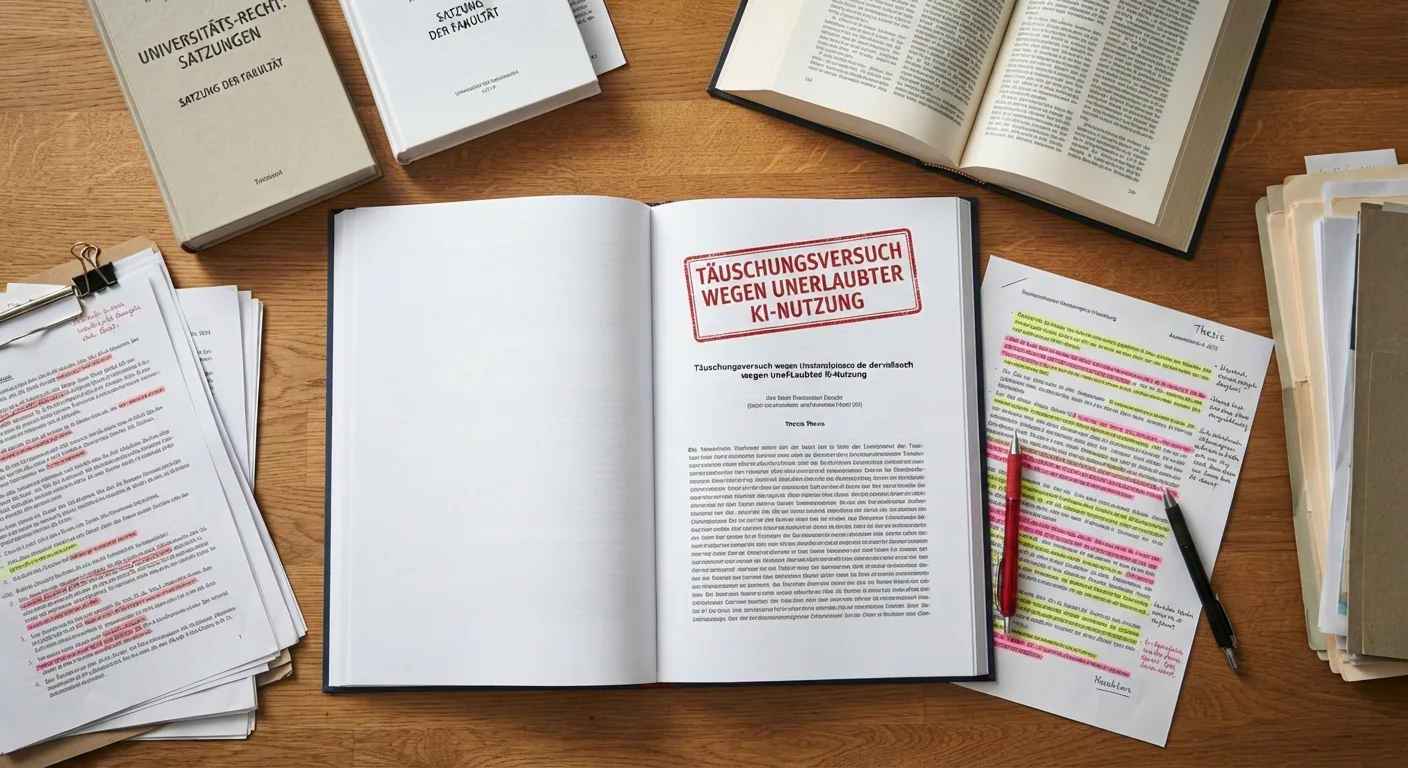 AI-generated
Two claims, two defeats
Two students at the University of Kassel brought claims against their university and lost. The university had accused both of them of using artificial intelligence as an aid in an examination. Because the deception was deemed particularly serious, it also barred the two from resitting the examination. The Administrative Court of Kassel, which has jurisdiction over disputes with state universities, dismissed the claims in judgments dated 25 February 2026 (case numbers 7 K 2134/24.KS and 7 K 2515/25.KS). The core message: anyone who produces an academic text with AI and does not disclose this is engaging in deception, and in a manner so serious that the university may refuse a resit.
The two cases differ in one respect. One student admitted using AI himself; in the other case, the university inferred it from circumstantial evidence. The most important indication: in writing, he knew more about the topic of his bachelor's thesis than he did in conversation. Anyone who is not allowed to resit an examination can no longer pass it. As a rule, that is the end of studying that subject.
AI assistance is outside assistance
The court confirmed the university's assessment: the students had made use of unauthorised aids, and that amounts to particularly serious deception. In examination law, the prohibition is termed “unauthorised outside assistance”. That sounds like it refers to people, for instance the fellow student who writes along, or the paid ghostwriter. In the view of the Kassel judges, that is not the point. Whether the assistance comes from a human being is irrelevant to the concept, and a language model that drafts paragraphs is outside assistance just like any ghostwriter.
There is a second consideration. In the court's view, anyone who produces an academic text with AI without disclosing it is already in breach of the rules of good academic practice. Those rules require a piece of work to demonstrate one's own achievement and to disclose contributions by others. An AI text passed off as one's own breaches both.
The difference from a Google search
Every student is allowed to google, so why not ask AI? The court addressed this objection. Classic source research via Google provides references that the student has to read, assess and put into their own words. This independent evaluation and use no longer takes place when AI supplies ready-made passages of text. On top of that, a source that is found is cited in the work, whereas the AI is not. The court therefore does not equate the use of AI with Google research.
The court leaves one exception open. The position may be different if the examination regulations expressly permit the use of AI subject to certain conditions. The examination regulations are the university's rulebook for examinations, and every student can consult them. Without such permission, the Kassel line applies: AI text without disclosure is deception.
How the court spotted the AI
In the second case there was no admission, so the university had to prove the use of AI, and the court had to be satisfied of it. The judges therefore described which indications point to an AI text. Symptomatic, they said, are frequently chosen, excessively repeated positively evaluative formulations applied to neutral technical content. A text that praises every method and declares every interim result remarkable catches examiners' attention. Another typical indication is repetitive summaries.
Added to this were two observations about the person. There was a striking gap between what the student submitted in writing and what he was able to say about his topic orally. He had also visibly struggled during the working period to understand the task, and then produced an almost complete piece of work strikingly quickly. The court assessed these indications in the round. Taken together, they were sufficient to satisfy it that AI had been at work.
Rules for AI in a bachelor's thesis
Under this judgment, whether AI is permitted in a bachelor's thesis, in a term paper or in any other examination is determined by the examination regulations. If they are silent, the position is: AI text without disclosure is unauthorised outside assistance. If they permit its use subject to conditions, those conditions are decisive, above all disclosure. What the AI has contributed must be identifiable in the work, just like any other source.
The second point concerns one's own achievement. What troubles the court is that with AI texts the independent evaluation and use is missing. On this logic, anyone who thinks through and writes their own work has little to fear, because they can explain in conversation what they have written. For parents who want to help their children with their studies, this is the most important point: under this judgment, an AI that writes whole paragraphs is a risk to the entire degree.
When the university alleges deception
Once the allegation is on the table, the situation is serious. The sanction in Kassel was exclusion from resitting the examination. Both claims against it failed: that of the student who had confessed just as much as that of the student whose use the university proved through circumstantial evidence. Students can challenge the university's decision before the administrative court, as the two from Kassel did. There, two questions arise: whether the examination regulations permit AI and whether the circumstantial evidence supports the allegation.
Anyone who can explain orally what they have written is in a better position than someone whose text knows more than they do. Drafts and notes that show the path to the finished work can also help. For it was precisely in the gap between text and author that the court identified the AI. According to the court's press release, the Kassel judgments were not yet final. The parties could lodge an appeal with the Hessian Higher Administrative Court within one month.
Conclusion
The Administrative Court of Kassel treats AI like any other unauthorised helper. Anyone who has examination texts written by an AI and keeps quiet about it is engaging in deception, and in a manner so serious that the university may refuse a resit. The position can only be different if the examination regulations expressly permit AI.
For students this means: the examination regulations determine whether and how AI is permitted, and what the AI has contributed must be disclosed in the work. The author should be able to say something in conversation about every sentence it contains.