Artificial intelligence
ALeKS: how the courts plan to publish more judgments with AI
Tobias Reinhardtapprox. 6 min read
Fewer than three per cent of all court decisions in Germany are published, because every judgment has to be anonymised by hand first. ALeKS, a project from the judiciary's digitalisation initiative, is meant to hand that work to an AI. Bavaria and Lower Saxony are developing it together, and Bavaria has been testing it at the Munich Higher Regional Court since March 2026.
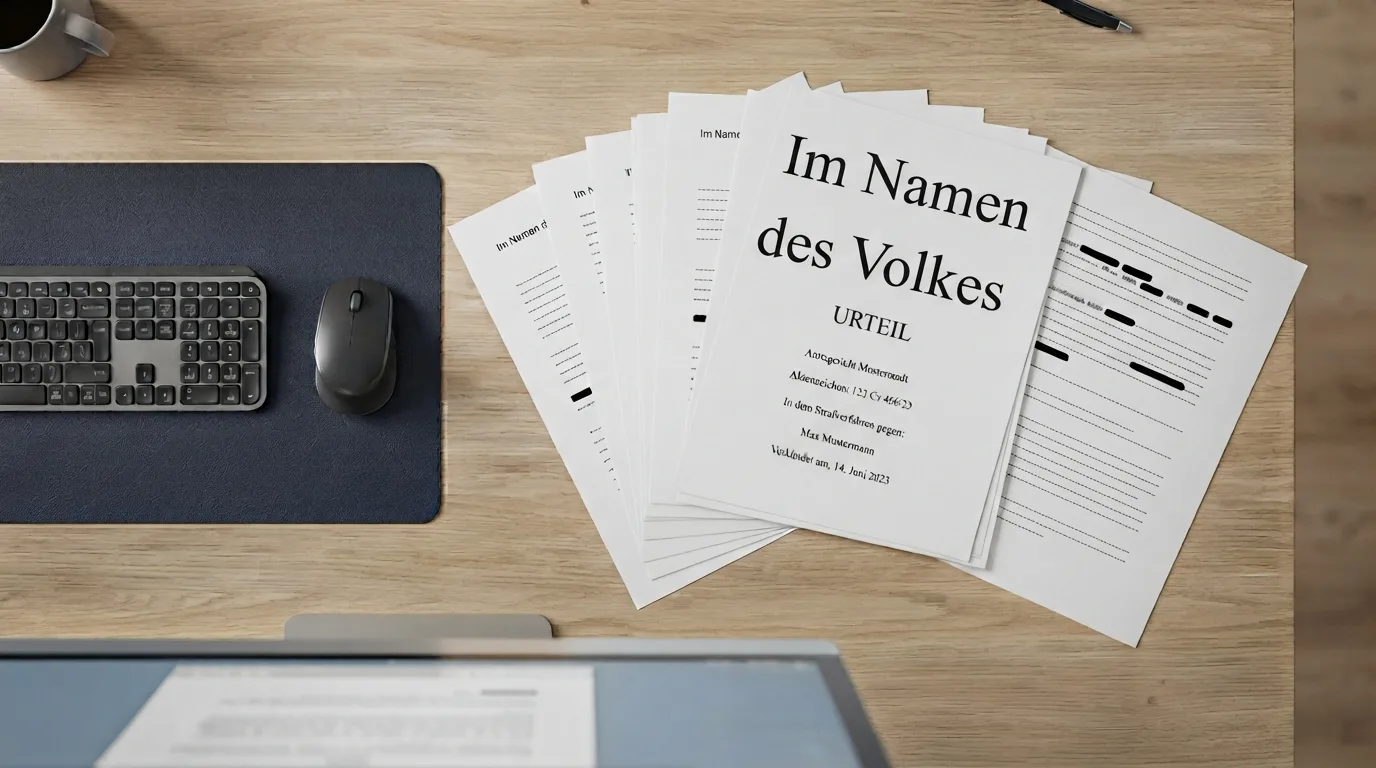 AI-generated
Three per cent is too few
Anyone looking for a local court judgment usually comes away empty-handed. According to the Federal Ministry of Justice, fewer than three per cent of all court decisions in Germany are published, and at the local courts the figure is lower still. The reason is manual work. Before a judgment can go into a database, court staff have to replace every name, address and other item of personal data. Then there are the metadata, such as court, date and file number. All of this takes time that the courts do not have.
ALeKS is meant to change that. An AI takes over the anonymisation so that the justice system can publish more decisions with the same staff. That is how the Federal Ministry of Justice describes the aim of the project, which is one of the Länder projects under the digitalisation initiative for the justice system.
What lies behind the name
ALeKS stands for „Anonymisierungs- und Leitsatzerstellungs-Kit zur smarten Veröffentlichung von Gerichtsentscheidungen“, a kit for anonymisation and headnote creation for the smart publication of court decisions. The name reveals a two-stage plan. In the first stage, an anonymisation tool built for the justice system identifies personal data in the text of a judgment and replaces it with abbreviations. In the second stage, large language models, the technology behind the well-known AI chatbots, are to formulate headnotes and tag the decision with keywords. Metadata such as ECLI, court, Land, date and file number are also to be captured automatically, and the finished decision sent out automatically. ECLI is the Europe-wide uniform identifier for court decisions.
Humans remain part of the process. Whether a judgment is published at all is still decided by the judge. After automatic anonymisation, service staff check the result by hand, as the Bavarian Ministry of Justice describes it.
Who develops and pays for ALeKS
Bavaria and Lower Saxony are jointly responsible. Bavaria had developed a prototype in a research project with Friedrich-Alexander-Universität Erlangen-Nürnberg. It works with computational linguistics, that is, software that analyses language according to rules and patterns. In early 2024, three practitioners from Lower Saxony tested various tools. The Bavarian prototype performed very well on recognition accuracy and usability. Since then, the two Länder have been developing it together.
The money comes from the federal government. For the digitalisation initiative it is providing up to 200 million euros from 2023 to 2026, up to 50 million per year. The Länder apply for their projects to the Federal Ministry of Justice, and the Budget Committee of the Bundestag decides. The federal government bears the development costs; later operation is shared between the federal government and the Länder according to the usual formulas. From 2027, a new Pact for the Rule of Law is to replace the initiative, with 210 million euros for the digitalisation of the justice system up to 2029.
Status: test operation and Project 50k
In Bavaria, ALeKS has been under test at the Munich Higher Regional Court since 9 March 2026. The Bavarian Ministry of Justice reports that the tool removes names, dates of birth and addresses in seconds where hours were previously needed. In May 2026, Minister of Justice Georg Eisenreich announced „Projekt 50k“: over the coming years, 50,000 judgments of the Bavarian justice system are to be anonymised and published. Central anonymisation units are being set up at the higher regional courts for this purpose.
Lower Saxony reports that in some areas of law the tool already replaces personal details with an accuracy of 97 per cent. The central IT operations unit of the Lower Saxony justice system is preparing for roll-out across the board. Hessen and Baden-Württemberg are going their own way with a tool called Jano.
What law firms gain from it
For lawyers, the publication rate is not an abstract problem. If you are litigating before a local court, you want to know how that court has decided in comparable cases. So far this rarely works, because the decisions never make it into a database. If the rate rises, so does the body of decisions that can be found, cited and compared. If the second stage arrives, ALeKS will supply headnotes and keywords along with them, and searching will become easier.
Eisenreich names a second benefit: published judgments are an important basis for training AI-based models. Anyone who wants to build legal tech applications for German law needs German judgments as training material. Three per cent is a thin basis for that.
Data protection and responsibility
The use of AI raises questions that the project itself does not answer. The first concerns data protection. Anonymisation does not just mean replacing names. A person can also be identified from the facts of the case, for instance through the combination of occupation, place of residence and a particular award. Whether the AI reliably finds such indirect clues has not yet been demonstrated. That is why review by humans remains indispensable for the time being.
The second question concerns traceability. With anonymisation, an error can be spotted by comparing with the original. With a headnote formulated by a language model, that is harder. A headnote that sharpens the decision in the wrong direction travels with it into the database and gets cited. Who stands behind it should be settled before the second stage begins. In 2025, the justice ministers of the federal government and the Länder issued a joint declaration on the use of AI. Under it, responsibility for decisions always remains with humans, and transparency is among the overriding principles. ALeKS offers a chance to observe what these principles look like in practice.
Conclusion
ALeKS is a tool for an old problem: German courts publish hardly any decisions because anonymisation by hand takes too much time. The AI first takes over this legwork, and in a second step headnotes and keywords as well. Judges still decide on publication, and staff check the result.
For law firms, this means more findable case law in the medium term, above all from the local courts. What remains open is how well the AI handles indirect clues pointing to individuals, and who stands behind machine-generated headnotes.